Civil Engineering Technology Diploma
| Type | Full Time |
|---|---|
| Length | 2 years |
| Campus | Prince George |
| Delivery | In Class |
| Fees* |
Check fee schedule
International To be announced
*All fees are an estimate. |
| Starting Semesters | Fall 2026 |
Overview
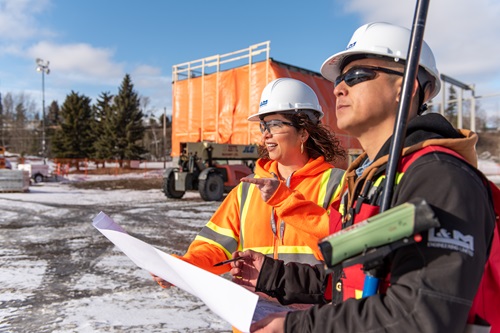
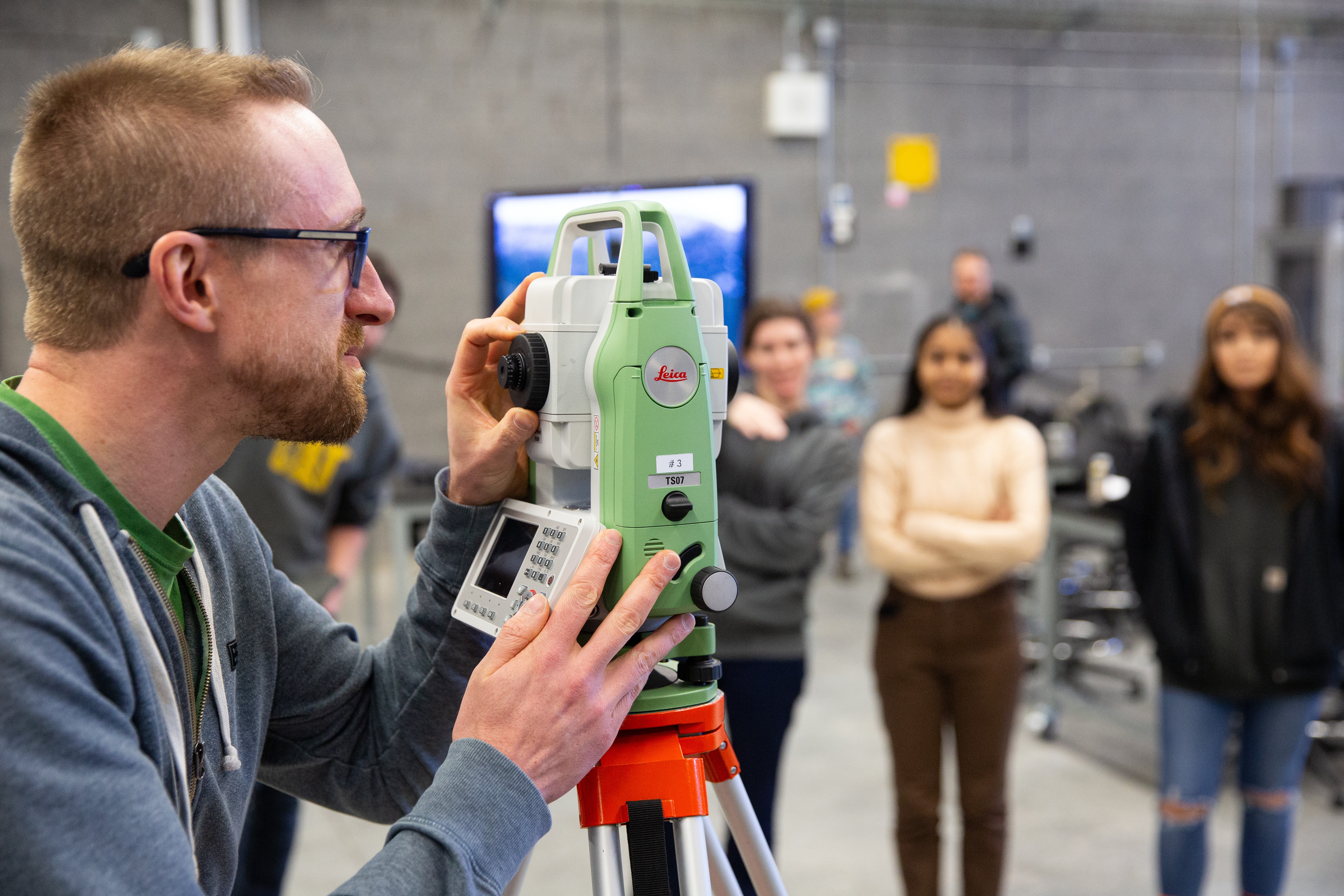
Earn a career as a Civil Engineering Technologist with this 2-year diploma program. As a Civil Engineering Technologist, you will be involved in planning, design and construction of roads, bridges, subdivisions, buildings, municipal services, and heavy infrastructure.
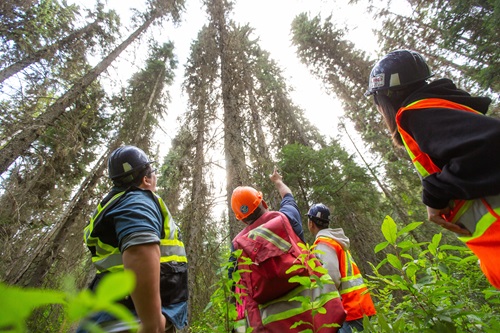
Civil Engineering Technologists work in a variety of environments including construction, forestry, mining, oil and gas, and transportation. They are an essential member of the engineering team who split their time between office and field work, and, when on-site, may work in urban, rural, and remote settings.
Careers
Upon completion of the Civil Engineering Technology program, you will be qualified for careers in government departments, consulting firms and construction companies in the following positions:
- Designers
- Estimators
- Testers
- Surveyors
- Inspectors
- Supervisors
- Technical Writers
- Project Coordinators/Managers
In northern BC, there is high demand from industry for Civil Engineering Technologists. Additionally, graduates may continue their education, transitioning to a university degree in engineering.
What You Will Learn
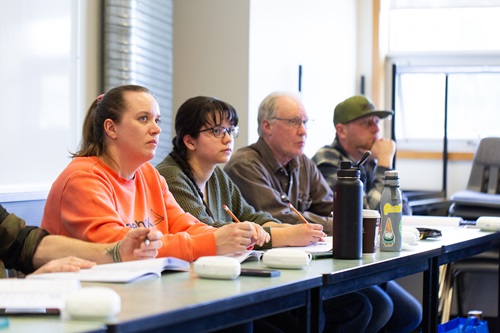
In the 2-year Civil Engineering Technology diploma program, students will learn relevant theoretical and practical knowledge to support their work within the broad field of Civil Engineering. Courses will be delivered with components of face-to-face classroom instruction, computer-aided design and modelling, field surveying, and experimental laboratory testing. Students will develop an understanding of the engineering principles used to perform structural, hydraulic, municipal, transportation, and construction materials design. Effective technical communication and project management skills will be emphasized throughout the program. Students can expect to spend an average of 31 hours per week in class and labs, with additional time spent studying, completing assignments, and doing research. CNC’s Civil Engineering Technology program explores the effects of northern, rural, and remote environments on Civil Engineering projects, with consideration of Indigenous perspectives.
More Media
Civil Engineering Technology - An International Perspective Video
Courses
Typical Offerings
| Timing | Fall Only, Every Year |
|---|---|
| Locations | Prince George |
Description
This course is a general introduction to the field of civil engineering, with focus on the roles and responsibilities of civil engineering technologists. Students will interact with practicing civil engineering technologists and civil engineers to learn about the subdisciplines of civil engineering. Additional introductory topics include sustainable development, environmental and societal impact, project development, standards and codes and ethics.Typical Offerings
| Timing | Spring Only, Every Year |
|---|---|
| Locations | Prince George |
| Requisites |
|
Description
This course explores skills required for success in a civil engineering technology career. Topics covered include goal setting, interviewing, communication, listening skills, teambuilding, personality types, critical thinking and conflict prevention and resolution. Students will prepare a Curriculum Vitae (CV) and learn how to market themselves. Diversity and equality, personal rights relating to violence and harassment, health and safety procedures and professional ethics will be emphasized throughout the course.Typical Offerings
| Timing | Fall Only, Every Year |
|---|---|
| Locations | Prince George |
| Requisites |
|
Description
This course explores the fundamental relationships between external forces, reaction forces and internal forces. Analysis is restricted to statically determinant, two-dimensional cases, with a focus on civil design applications. Students will develop their knowledge in the following areas: 2D force vectors, equilibrium equations, support conditions, free-body diagrams, truss analysis by the methods of joints and sections, analysis of pinned plane frames, geometric properties of sections, distributed loading, and load, shear force and bending moment diagrams for beams.Typical Offerings
| Timing | All Terms, Every Year |
|---|---|
| Locations | Prince George, Quesnel, Mackenzie |
Description
ENGL 113 introduces students to the principles and practices of effective written and oral communications in English as applied in current academic, business, and technical contexts in university course levels. Instruction will emphasize grammar, punctuation, style, and presentation as important elements applied to a wide variety of writing and speaking situations: e-mail, letters, reports, and instructional and persuasive talks. Research strategies will be practiced.Typical Offerings
| Timing | Spring Only, Every Year |
|---|---|
| Locations | Prince George |
| Requisites |
|
Description
This course explores the relationship between applied loads and material stresses and strains with a focus on those developed in common structural elements. Students will develop their knowledge in the following topics: concepts of stress and strain, material testing, allowable stresses and factors of safety, analysis of statically determinate and indeterminate axially loaded bars, thermal stresses, moments of inertia, beam stresses and deflections, column buckling, stress transformations and Mohr's circle. A laboratory component is included in this course.Typical Offerings
| Timing | Fall Only, Every Year |
|---|---|
| Locations | Prince George |
| Requisites |
|
Description
This course explores the fundamental graphical techniques necessary for civil engineering technology. With a focus on computer-aided design (CAD), and an introduction to manual drafting techniques, students will develop skills required to produce basic civil engineering drawings. Additional topics include reading topographic and engineering drawings, scaling and plotting, and general CAD skills.Typical Offerings
| Timing | Spring Only, Every Year |
|---|---|
| Locations | Prince George |
| Requisites |
|
Description
This course is a continuation of CIVE 120, Digital Design and Drafting I. Students will continue to develop skills using computer-aided design (CAD) programs, with emphasis on advanced features. Students will create three-dimensional models using wire meshes, surfaces, and solid models. CAD skills will be augmented with software that streamlines 3D design and supporting documentation. Additional topics include plans, elevations, sections, bill of materials, and schedule of quantities. Geographic Information Systems (GIS) applications to civil engineering will also be introduced.Typical Offerings
| Timing | Fall Only, Every Year |
|---|---|
| Locations | Prince George |
| Requisites |
|
Description
This course explores the fundamental concepts of hydrology and its application to civil engineering. Students will develop knowledge to analyze watersheds and design storm sewers. Specific topics include rainfall intensity, the hydrologic cycle, mass balance, watersheds, contour maps, hydrographs, streamflow models, storm events, streamflow measurement, infiltration, groundwater, snowmelt quantification, and storm sewer design.Typical Offerings
| Timing | Spring Only, Every Year |
|---|---|
| Locations | Prince George |
| Requisites |
|
Description
This course explores fluid flow in pipes and open channels. Students will improve their understanding of fluid properties, hydrostatic pressure and hydrostatic forces before applying their knowledge to pipe systems. Students will learn to design pipe-pump systems by applying their knowledge of continuity, Bernoulli's equations, energy grade lines, head losses, pump characteristics, network analysis, pipe forces and costs. Open channel design concepts will include the Manning equation, energy principles, chokes, varied flow profiles and control structures.Typical Offerings
| Timing | Fall Only, Every Year |
|---|---|
| Locations | Prince George |
| Requisites |
|
Description
This course explores the principles of soils and aggregates and is delivered through lectures and laboratory sessions. Students will learn sampling methods, soil classification, analysis of materials, and compaction and density theory in accordance with ASTM International (ASTM) standards. Topics covered include mass/volume relationships, identification of moisture content, applications of geosynthetics, liquid and plastic limits, and preparation of summary reports. The importance of working safely in a laboratory and on-site will be emphasized throughout.Typical Offerings
| Timing | Spring Only, Every Year |
|---|---|
| Locations | Prince George |
| Requisites |
|
Description
This course expands on knowledge gained in CIVE 140, Construction Materials I, and introduces students to basic geotechnical design principles, and mixing and testing of concrete and asphalt. Through lectures and laboratory sessions, students learn the influence of geology on soils, cement types, concrete properties, batching to finishing techniques, compressive strength, quality control, and inspection requirements. Additional topics covered include consolidation and shear testing of soils, steel reinforcement, asphalt mix design, and pavement data collection and assessment techniques.Typical Offerings
| Timing | Fall Only, Every Year |
|---|---|
| Locations | Prince George |
| Requisites |
|
Description
This course explores the principles of surveying required to collect elevation and topographic data for civil engineering projects. Students will apply the required skills to complete level loop and traversing, measurement of distances and angles, and mathematical calculations to analyze and adjust data. Additional topics covered include equipment set up and calibration, grade and cut/fill determination, stationing, and field notes and format. Equipment care and safety are emphasized throughout the course.ut.Typical Offerings
| Timing | Spring Only, Every Year |
|---|---|
| Locations | Prince George |
| Requisites |
|
Description
This course expands on knowledge gained in CIVE 150, Surveying I, and introduces students to additional surveying methods. Topics covered include measurement and calculation, simple plane surveying, calculating and adjustments, levelling, curves, cross-sections and plans, volume calculations and detail survey. Students will apply the required surveying skills to complete road, building, and elevation layout.Typical Offerings
| Timing | Fall Only, Every Year |
|---|---|
| Locations | Prince George, Quesnel, Burns Lake, Mackenzie, Vanderhoof |
| Requisites |
|
Description
This course explores the basic theory, techniques and application of algebra, geometry and statistics as required to solve problems in Civil Engineering Technology. Topics will include trigonometry, linear, quadratic, exponential and logarithmic functions, analytic geometry, vectors, and statistical methods including data summarization, probability, normal distributions, sampling distributions, confidence intervals and linear regression. Applications to civil engineering are emphasized throughout the course.Typical Offerings
| Timing | Spring Only, Every Year |
|---|---|
| Locations | Prince George, Quesnel, Burns Lake, Mackenzie, Vanderhoof |
| Requisites |
|
Description
This course expands on knowledge gained in MATH 180, Mathematics for Civil Engineering Technology I, and will cover topics in calculus and matrix algebra necessary for Civil Engineering Technology. Topics will include limits, derivatives of algebraic, trigonometric, logarithmic and exponential functions, definite and indefinite integrals, differential equations, matrix operations and inverses, and solving systems of linear equations using matrices. Applications to civil engineering are emphasized throughout the course.Typical Offerings
| Timing | Fall Only, Every Year |
|---|---|
| Locations | Prince George |
| Requisites |
|
Description
This course explores the connections between civil engineering and the larger framework of society and the environment. Students will learn about the environmental effects of engineering and sustainable design. Social impacts of civil projects will be explored with emphasis on health and safety and public consultations. These topics will be discussed within the framework of northern and/or rural ecosystems. Specific topics include environmental pollution, site assessment and remediation, sustainable engineering, environmental life cycle analysis, health and safety, and public consultation.Typical Offerings
| Timing | Fall Only, Every Year |
|---|---|
| Locations | Prince George |
| Requisites |
|
Description
This course explores the basic concepts of structural design in accordance with national and provincial building codes. Students will learn the structural design process and how to design wood structural elements. Specific topics include limit states design, dead loads, occupancy loads, snow loads, wind loads, load paths, wood tension members, wood columns, wood beams, and wood connections.Typical Offerings
| Timing | Spring Only, Every Year |
|---|---|
| Locations | Prince George |
| Requisites |
|
Description
This course is a continuation of the content in CIVE 210, Structural Design I. Students will further their understanding of structural analysis by applying concepts to structural members made of steel and reinforced concrete. Specific topics include structural indeterminacy, qualitative analysis, design of steel structures (tension members, columns, beams and beam-columns), and design of concrete structures (beams, one-way slabs, columns, footings and retaining walls).Typical Offerings
| Timing | Fall Only, Every Year |
|---|---|
| Locations | Prince George |
| Requisites |
|
Description
This course explores the use of computer software to conduct analyses and produce civil engineering designs. Students will learn to use spreadsheets and computer programming to automate routine computational analyses. Emphasis will be placed on practical civil engineering applications, and course content will be explored through a combination of lectures, computer lab simulations and a project.Typical Offerings
| Timing | All Terms, Every Year |
|---|---|
| Locations | Prince George |
| Requisites |
|
Description
This course includes both the theory and practice of writing for the workplace. Students will first learn the rules and guidelines of professional communication and then will move beyond them, investigating the underlying theory, ethics and social factors that contribute to the challenges of work writing. This course introduces strategies for communicating effectively to a variety of audiences in a variety of workplace genres. Students work both individually and in collaboration, completing both written and oral projects that are relevant to their professional goals and the requirements of the business, technical, and professional communities. Prerequisites: ENGL 103 Note: Natural Resource and Environmental Technology (NRES) students will be admitted with successful completion of ENGL 103 and completion of all first-year courses.Typical Offerings
| Timing | Spring Only, Every Year |
|---|---|
| Locations | Prince George |
| Requisites |
|
Description
This course explores remote and rural water supply, wastewater and solid waste management. Through lectures, case studies and field trips, students will learn about reservoirs and dams, safe drinking water, common contaminants, purification requirements, soil erosion, sediment control, wastewater treatment, solid and hazardous waste, and engineered landfills. The impacts of water waste and solid waste on the environment will be a focus throughout the course.Typical Offerings
| Timing | Fall Only, Every Year |
|---|---|
| Locations | Prince George |
| Requisites |
|
Description
This course explores the design of resource roads, urban streets and rural highways according to applicable guidelines and standards. Topics include roadway classification, corridor requirements, vertical and horizontal elements, and properties of road cross-sections. Students will prepare designs and drawings for the different road types with focus on drainage, intersections and earthworks balancing.Typical Offerings
| Timing | Spring Only, Every Year |
|---|---|
| Locations | Prince George |
| Requisites |
|
Description
This course explores the concepts of land development and the application of industry-standard software to prepare engineering plans. Topics covered include property rights and ownership, the consultation process, subdivision requirements, survey types and legal constraints, drawing templates, surface analysis, and collection, interpretation and use of field and digital data. Students will complete a land development project drawing package that meets municipal standards.Typical Offerings
| Timing | Fall Only, Every Year |
|---|---|
| Locations | Prince George |
| Requisites |
|
Description
This course explores planning and design of a residential subdivision using the Local Government Act, municipal bylaws, and zoning guidelines. Using computer-aided design (CAD) software, students will prepare drawings showing lot layout, roadways, intersections, site servicing, stormwater management, open space, and pedestrian circulation. Additional topics covered include land-use planning, stakeholder involvement, the development and rezoning process, and calculation and analysis of development costs.Typical Offerings
| Timing | Spring Only, Every Year |
|---|---|
| Locations | Prince George |
| Requisites |
|
Description
This course builds on the skills learned in ENGL 229. Students will plan and write a progress report and a formal report for an industry-sponsored project, as well as any related documentation for the project as needed. Students will also design and create a static display and present the project orally with professional visuals. Students will also prepare a professional resume and letter of application.Typical Offerings
| Timing | Spring Only, Every Year |
|---|---|
| Locations | Prince George |
| Requisites |
|
Description
This course expands on knowledge gained in CIVE 250, Municipal Design I. Students will prepare an industry-standard engineering package, including plan and profile drawings detailing utility servicing, for a residential subdivision. Topics covered include site preparation, utility sizing and alignment, site drainage, culvert analysis and erosion protection, and domestic water and fire protection criteria. Use of local bylaws and applicable guidelines will be a focus throughout the course.Typical Offerings
| Timing | Fall Only, Every Year |
|---|---|
| Locations | Prince George |
| Requisites |
|
Description
This course explores the fundamentals of traffic planning in an urban setting. Students learn about data collection techniques, analysis of traffic patterns, roadway and intersection capacity limits and layout, and preparation of traffic management plans. Topics covered include traffic control devices, signal timing, impacts from development, signalized, unsignalized and roundabout intersections, parking, pedestrian and bicycle facility requirements, and crash analysis using historical data.Typical Offerings
| Timing | Fall Only, Every Year |
|---|---|
| Locations | Prince George |
| Requisites |
|
Description
This course explores the concepts involved in managing a typical civil engineering project. Topics covered include fundamentals of construction, estimating, contract law and contract administration. Students will learn about safety and training, construction equipment and methods, preparation of contracts, permitting requirements, and budgeting procedures. The importance of ethical behaviour while managing a project will be emphasized throughout.Typical Offerings
| Timing | Spring Only, Every Year |
|---|---|
| Locations | Prince George |
| Requisites |
|
Description
This course expands on knowledge gained in CIVE 270, Project and Construction Management I, and students will further their understanding of managing a civil engineering project. Topics covered include project planning, interpreting construction drawings, take-offs, scope management, coordination and communication, and inspection. Students will learn about critical path analysis, scheduling the construction process, cost control, and documentation procedures. Construction safety and security will be emphasized throughout the course.Typical Offerings
| Timing | Spring Only, Every Year |
|---|---|
| Locations | Prince George |
| Requisites |
|
Description
This course provides students with the opportunity to work as a team to plan and execute a civil engineering design project. Students will work with a faculty advisor to complete their project on schedule and to an appropriate industry standard. The formal written report will be submitted in conjunction with ENGL 252, Technical Writing and Communication, and teams will present their findings to faculty and peers.Entry Requirements
Fall 2027 Intake and Onwards
For applications to the Fall 2027 intake (September start), you must meet the following requirements:
- Standard Admission Requirements
- The following courses or their equivalent:
- Foundations of Mathematics 12, MATH 050, or equivalent (minimum ”C+”)
- Physics 11 or PHYS 045 (minimum “B”) or Physics 12 or PHYS 050 (minimum C) or equivalent
Need help meeting these requirements? Check out our Academic Upgrading options.
*Note: It is highly recommended that required admissions courses be completed within the past five years. If more than five years has elapsed, upgrading the required subjects is suggested. This is due to the heavy emphasis on math and physics in the CNC Civil Engineering Technology Program curriculum.
English Requirements
Candidates whose first language is not English must meet the English requirements and provide proof of English language proficiency through one of the following:
- Test of English as a Foreign Language (TOEFL iBT) score of 4.5 overall with no section less than 4.0 or equivalent, within the last two years; or
- International English Language Testing System- Academic (IELTS Academic) score of 6.5 overall with no band below 6.0, taken within the last two years; or
- A 3-credit post-secondary-level English, Communications, Creative Writing, or Literature course with a minimum “B-“ grade, taken at a post-secondary institution located on the approved English-speaking country list.
Bring Your Own Device
Civil Engineering Technology at CNC is a bring your own device (BYOD) program. The course content contains a substantial amount of computer-aided design (CAD), which will be performed both in-class and at home. Your device will be used to access a virtual desktop, where you will find the CNC-provided software for your course.
Student licensing is provided to all Civil Engineering Technologist students for the most current version of Autodesktm software applications used in the program. Students are expected to provide a laptop capable of running this software. To locate the computer system requirements please visit the Autodesk website and search their products for Civil 3D.
Note: The Autodesk website lists “Additional Requirements”, these are not required for the Civil Engineering Technologist program.
Selection Process
If there is room in the program, you will be accepted once you have met all the admission requirements. This is called “first qualified, first accepted.” If you qualify after the program is full, you will be put on a wait list.
Locations & Dates
CNC programs have varying lengths and start dates to meet your needs, and are offered across multiple campuses where possible. Don’t see the campus you’re looking for? Check back with us soon as this page is updated throughout the school year.
| Type | Campus | Starts | Status |
|---|---|---|---|
|
|
|
Open for Applications |
Invest in your future
Check the for the most updated information.
Books for this program can be purchased from the bookstore.
Paying for college
We're here to help. You can apply for scholarships and bursaries through CNC. We can also help you find loans and other funding.
Salaries and employment
Looking for a job? Check the student employment opportunities board.